
The town is asking me to leave, the cremation ground is inviting me
They were eager to share stories from their childhood, adult lives, and the current sunset years. Their stories and experiences of resilience in the face of hardships, loss of their loved ones, raising their children, caring for their parents while they worked to put food on the tables floored me.
ఊరు పొమ్మంటుంది కాడు రమ్మంటుంది
“What are you doing?” asked an elderly lady. I looked up, stopping my email in mid-sentence and spotting an elderly lady standing in front of me to say hello. I recognized her as Amma’s next-door neighbor at the senior care facility. I had seen her sitting in a chair on the veranda in front of her room and at mealtimes in the cafeteria. “I am working.“ I replied with a smile to put her at ease in case she felt bad about disturbing me. ”You are Kusuma's daughter, aren’t you?” she asked. I said, “Yes, I am visiting Amma staying in a guest room a few doors down the corridor,” anticipating her next question. Then she said, "What’s with people these days? It is all about making money. They don’t make time to visit their parents, and have to work even when they come to see them.” I could hear disdain and judgment in her words and demeanor.
I was taken aback, not knowing how to respond at first, paused and took a deep breath before I replied, “I have two sons to take care of and pay for their education. I am fortunate that my job allows me to work remotely while I spend time with Amma.” She immediately laid down her arms, turning off the disdain and looking at me with a gentle gaze, introducing herself, "My name is Kamala and I live in the room to the left of your mother’s.” Kamalamma started asking me about my spouse and children. After chatting for a few minutes, she walked away to leave me to work, but later that evening she invited me to her room for a chat. She was a good-looking woman in her 80s, who looked more than ten years younger than her biological age, dressed in an onion-pink colored cotton cheera (saree) and a white blouse reminding me of my grandmother. Unlike my grandmother, she wore veebudhi (holy ash) on her forehead without a bottu (kumkum dot) signifying widowhood, following the Hindu tradition of not wearing a bottu after her husband’s death.
During the next two weeks of my stay, it had become a routine for me to stop by to say good morning and goodnight to her as I walked past her room to Amma’s and back to mine. She talked about her husband, children, their spouses, and grandchildren. She said she stayed with her son in Australia for a few months and came back home to be in familiar surroundings and people who can speak Telugu. She was in good health and walked independently without needing a walking stick or a walker in spite of her double hip and keen surgeries. She encouraged me to ask Amma to walk more so she could retain her strength and balance, saying, “I keep asking your mother to walk more. She has been losing her strength and falling often.” I nodded in agreement and assured her that I would speak to Amma.
Kamalamma being much more social than Amma, introduced me to her neighbors and others living there. She waited for a lady, Sri Lakshmi, who was Amma’s next-door neighbor to the right, to walk to the cafeteria at mealtimes. Sri Lakshmi looked too young to be a grandmother, but to my surprise, she had two granddaughters and the older one was a few years older than my younger son. I gathered that she was at least ten years younger than me, a widow, and that one of her sons lived in a nearby town, but she chose to live here at the senior care facility to be independent. I surmised she got married when she was in her teens. She was friendly and eager to accompany elderly people as they walked to the cafeteria and back.
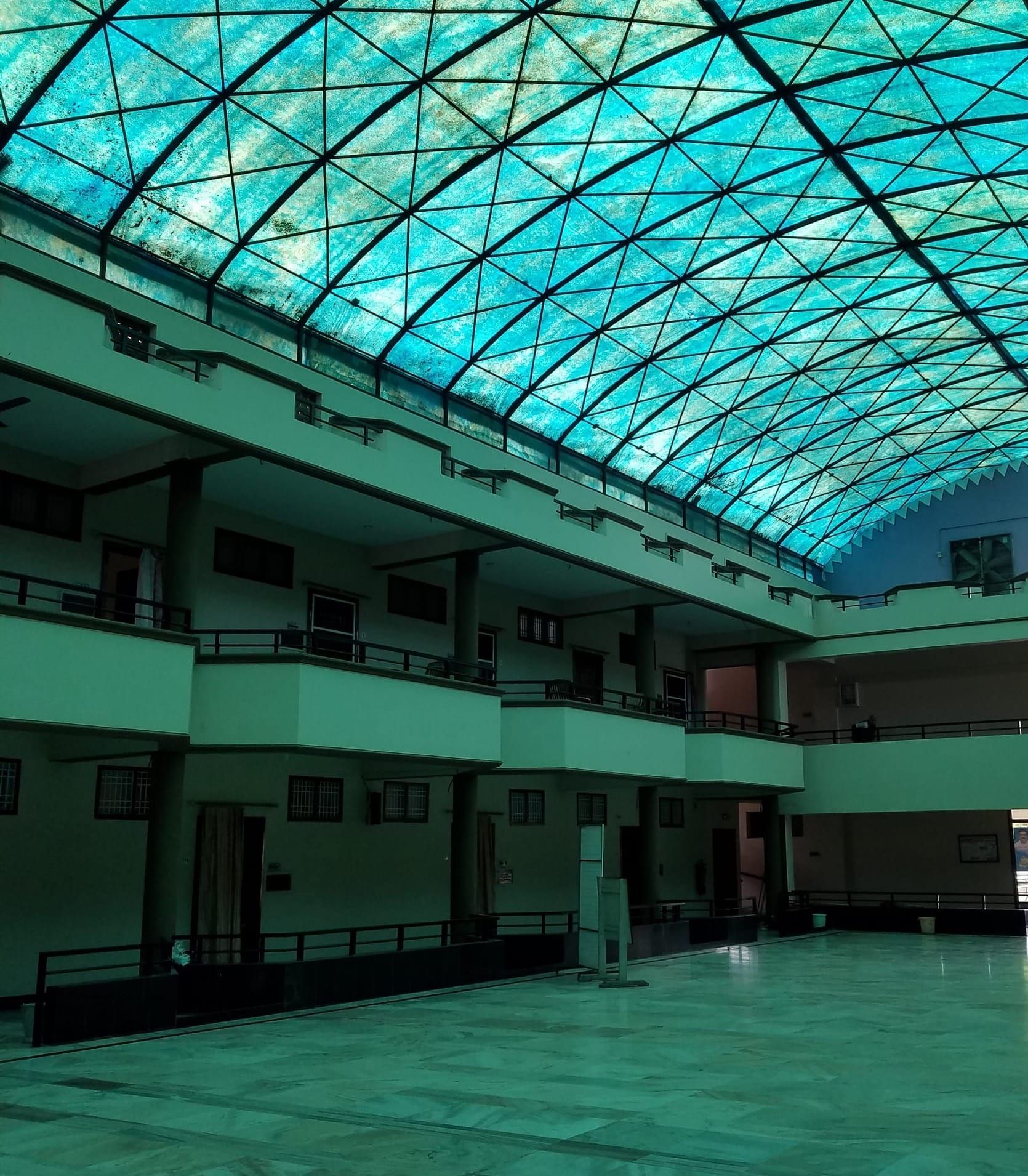
The 3-story, oval-shaped senior care building had rooms along the outer ring of the oval that open onto a common veranda in the front and a balcony in the back for clothes lines and a bathroom on the first two floors. The third floor was built like a hotel with a long corridor with rooms on either side of it. There is a large atrium at the center spanning the three storeys of the oval that is covered with a ceiling to let the sunlight in. Standing on the veranda outside the rooms on the second floor, you could look down into the atrium below. Their cafeteria and medication room were on the first floor. The facility grew vegetables and fruits on their grounds and in their container garden on the flat roof. The facility reserved 25% of their rooms for people who couldn't afford it, offering them free lodging and boarding.
I had the pleasure of connecting with many elderly men and women who lived there during breakfast, lunch, and dinner gatherings in their cafeteria. Some chose to live independently like Amma, even though their children would have liked to take care of them and others didn’t have a choice but to live there for a variety of reasons. Some didn’t have any children and others didn’t get along with them. As I got to know them better, I could sense that they were lonely and wanting company. They were eager to share stories from their childhood, adult lives, and the current sunset years. Their stories and experiences of resilience in the face of hardships, loss of their loved ones, raising their children, caring for their parents while they worked to put food on the tables floored me. Even though I am doing all of those things myself, their lives felt much harder than mine.
Some stayed in their rooms as they chose solitude and others congregated on verandas to socialize. While some people stayed by themselves, others had roommates. Kamalamma said, “Unlike your mother, I need a roommate for financial and emotional reasons. I would have stayed back in Australia, but I felt lonely there. Everybody leaves home in the morning and comes back in the evening. They are usually busy with their lives. Not being able to speak English made it difficult for me to communicate with neighbors and make friends. I decided to come back and found this place. I am surrounded by people of my own age here.” I nodded in agreement and said, “I totally understand. Amma felt the same way when she lived with me and my family in the US after Nanna passed away. She came back for the same reasons.”
When it was time for me to head back home, I stooped by her room to say bye. She said, “I hope I get to see you again on your next visit.” I introduced my spouse and younger son to her on my next visit a year later, as Kamalamma eagerly greeted me saying that she was happy to see me and meet my family. It was in the middle of summer when I went there for another visit soon after. She didn’t look much older, but she lacked her usual spark. She said the summer heat had been unbearable. I realized that she didn’t have an air conditioner in her room like Amma did. I was hiding out in my room with the air conditioner running full blast day and night, and it would be impossible to feel comfortable without an air conditioner. People get air conditioners installed when they move in if they can afford one. I surmised Kamalamma was on a limited budget and couldn’t afford one.
As I walked past her room in the afternoons, I would see her lying down on her bed looking tired. One afternoon, she hurriedly came into Amma’s room as we were both sitting down chatting, asking Amma if she could sit in the room to cool down. I got up to offer my chair, noticing that she looked exhausted and out of breath with her blouse drenched in sweat. She sat for a while and then left. Amma invited her to stop by whenever she felt the need to cool down and invited her to sleep on the spare bed at night. She took Amma’s offer to stop by to cool down in the afternoons, but declined to use the spare bed to sleep at night.
When I stopped by to say bye, Kamalamma looked exhausted as she said, “I hope I am still here when you come for a visit next time. I am at an age, the town is asking me to leave, the cremation ground is calling me to come over.” I gave her a big hug and kissed her frail cheeks. She passed away a few months later and wasn’t there when I went to see Amma a year later.