
Veranda Tales-Arbitrating Monkey
కోతి తీర్పు (kothi theerpu) Once upon a time, there lived two kittens, named Ramu and Shyamu, in a forest. They were playful and always on the go. They played, hunted, and found a safe place to sleep at night. They often shared food with each other.

కోతి తీర్పు (kothi theerpu)
Once upon a time, there lived two kittens, named Ramu and Shyamu, in a forest. They were playful and always on the go. They played, hunted, and found a safe place to sleep at night. They often shared food with each other. One day, they both spotted a delicious దోశ (dosa) under a tree. Some poor human walking by must have dropped their lunch. They both lunged for it and one of them got their hands on the dosa. Dosa smelled delicious and looked appetizing. It was too hard to resist the temptation to eat it all.
They started arguing about who should have it. They couldn’t agree on whether they should share it or one of them should have it all. Since Ramu got his hands on the dosa, he wanted to eat it all. Shyamu said, “That is not how we do things. We both spotted the dosa and we should share it!”. Ramu said he should get a bigger share and Shyamu didn’t agree. After arguing for a while, they agreed that it is only fair to share the dosa since they both spotted it. However, neither of them could trust the other to divide the dosa into equal parts.
They didn’t realize a monkey, named Vali sitting up in the tree above them was watching and listening in on their conversation and argument. Vali had been watching the kittens for a while. He would watch them as they played together and shared food they found with each other. This dosa was too hard for Vali to resist. He came down from the tree to help resolve the conflict. He told the kittens he can divide the dosa for them in equal parts and since he was the third party and didn’t have any interest in dosa they should trust him to be fair.
Vali’s proposal sounded reasonable to Ramu and Shyamu and they agreed to have Vali mediate and resolve their conflict. Vali took the dosa and broke it into two parts. He examined the two pieces and said, “Oops, one of them looks bigger than the other”, and took a few bites from the bigger piece. Then he examined the two pieces and said - you guessed it, “Oops, now the other one looks bigger'', and proceeded to take a few bites from the bigger piece. This routine continued until the entire dosa ended up in the monkey’s tummy. This all happened so quickly and by the time the kittens realized what was happening, the dosa was gone.
The kittens were very sad that they didn’t get even a small piece of the food they found. They were also sad that their fighting over the dosa instead of wisely choosing to share it led to the monkey stealing all of it from them. They realized when two people fight over valuable things, third person benefits. They were wiser and learned from their mistake to not repeat it ever again. What our two kittens didn’t know is that this plays out everyday in the human world. It so happens, generation after generation, humans who hear this story don’t seem to learn what it teaches. When two parties fight over property or money, the third party benefits. Lawyers get involved charging fees by the hour and next thing you know, the money disappears. The world can be a better place if we can learn and benefit from such ancient wisdom.
I heard this story many times as I was growing up. This story is from పంచతంత్ర (Panchatantra), an ancient collection of interrelated Indian animal fables in Sanskrit. Panchatantra is an original Sanskrit word meaning Five Treatises and it means the same in Telugu. Even though Telugu is a Dravidian language, it adopted several Sanskrit words. The Telugu language has an unbroken, prolific, and diverse literary tradition of over a thousand years.
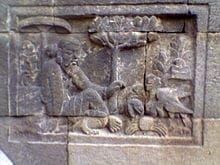
The Panchatantra prelude section credits Vishnusharma as the author who wrote these stories to teach the principles of good government to his students, the three princes of Amarasakti. The Panchatantra has been widely translated into several Indian and non-Indian languages, and the earliest known non-Indian translation in Middle Pesrian or Pahlavi by Burzoe, dates back to 550 CE. The Panchatantra stories can be seen on temple reliefs like this one at the Mendut temple, Central Java, Indonesia.
Sanskrit literature is very rich in fables and stories and these stories have been in Indian cultural memory for thousands of years. It is a shared treasure trove of knowledge which is passed down from one generation to another. As a result, it is very safe to say every child who has grown up in India would have heard this story from family, teachers, and friends. I heard this story in Telugu and in Hindi as बन्दर बाँट (Monkey divides). The moral of the story is that being greedy is unprofitable . People can benefit greatly from cooperating and resolving problems without involving third parties as much as possible. The kittens could have resolved their conflict within themselves by choosing one of them to divide dosa into equal parts and the other to pick first. This way whoever takes the responsibility to divide the dosa is forced to be fair and make sure the two pieces are indeed equal. If they don’t they will end up getting the smaller piece since the other kitten gets to pick first. Instead they ended up losing the entire dosa to the monkey.