Quest for Sungudi sarees
“Hey, do you remember running around Panaji looking for Goan traditional Kunbi handloom sarees on our Goa trip last year?” my spouse asked me as we were heading out on our trip to Tamilnadu. I smiled and said, "How can I forget? No one knew where to find them. Do you remember the lady we ran into at the Co-Optex store? Upon overhearing me asking the salesperson at the counter about Kunbi sarees, she offered to call her friend who is in the textiles business." My spouse said, "Yes, I didn't think anything would come out of that when she couldn't reach her friend. She then came running back into the store while we were paying for the Kanchipuram silk saree we bought, and told us where to find Kunbi sarees.” I said, "Then we were on a mad dash to get there before the store closed and finally found them in that small store. Sadly, the sarees were too heavy to bring back in a small carry-on with the strict airline weight restrictions. I had to settle for Kunbi scarves instead”, as I adjusted the Kunbi scarf I was wearing.
I continued, "The store had a disappointingly small selection, a short stack of ten or twelve sarees and another one of scarves about the same size. The two women at that store looked amused that we had gone looking for Kunbi sarees all over town and were happy that we had found their store. " My spouse said, "I think they were amused looking at you wearing yoga pants, shirt and sporting hiking shoes looking for traditional Kunbi sarees." I giggled, "Yes, that very well could be the reason why they were amused. Though they were disappointed that I didn't buy a saree. India continues to amaze me, people go out of their way to help. This lady did not hesitate to approach us to say that she overheard us and that she could help."
When I travel to India and other countries, I look for traditional artwork and handloom clothing unique to those places. I heard about Kunbi handloom cotton sarees woven by Goan tribal people and how they are becoming rare as the cottage industry is in decline as younger generations of tribal people no longer learn the craft, choosing to seek other occupations instead. These sarees are woven in beautiful checkered patterns using cotton threads in brilliant colors. India is home to thriving cottage industries that weave silk and cotton sarees on their looms. Cities across India are known for their traditional woven sarees; Kanchipuram, Benaras, Dharmavaram, Venkatagiti and Lepakshi are among the well-known cities that are known for their traditional handloom sarees.
My spouse, teasingly with a twinkle in his eyes, said, "Now that we went over that adventure again, I will give you another thing to chase down when we are in Madurai: the sungudi sarees." I gave him a huge hug and a kiss for his research to find out about Madurai traditional weave for me. We now had a mission to find sungudi sarees when we were in Madurai. "Jigarthanda, a special Madurai sweet cold beverage made from cream, cashews, almonds and other nuts, is on our list to try. We can look for both when we are in Madurai," I said. My uncle, who is a walking encyclopedia of Indian history, chimed in with: "Sungudi weave originated in Gujrat and when people from there migrated to Madurai several centuries ago, they brought it with them."
When we reached Madurai, I scoped out the clothing stores within walking distance from our hotel. On our Tamilnadu road trip, we got started early each day, leaving time for some downtime in the hot hours of the afternoons. These afternoon hours were my time for solo exploration, walking the streets, connecting with people, looking for local crafts, food, drinks, sarees and blouses. Walking is the best way to explore, talk to people and get to know the city and its unique culture. When we zip by in a moving vehicle, all cities look the same. My spouse accompanies me even though he doesn’t enjoy walking along the dusty and not so clean streets in India. He complains about needing to constantly dodge people, cycles, auto-rikshaws, two-wheelers, vendor's carts, cars, street dogs and cows. But I am glad he gives me company when I go exploring, as it is the best way to experience any city, witnessing the best and the worst.
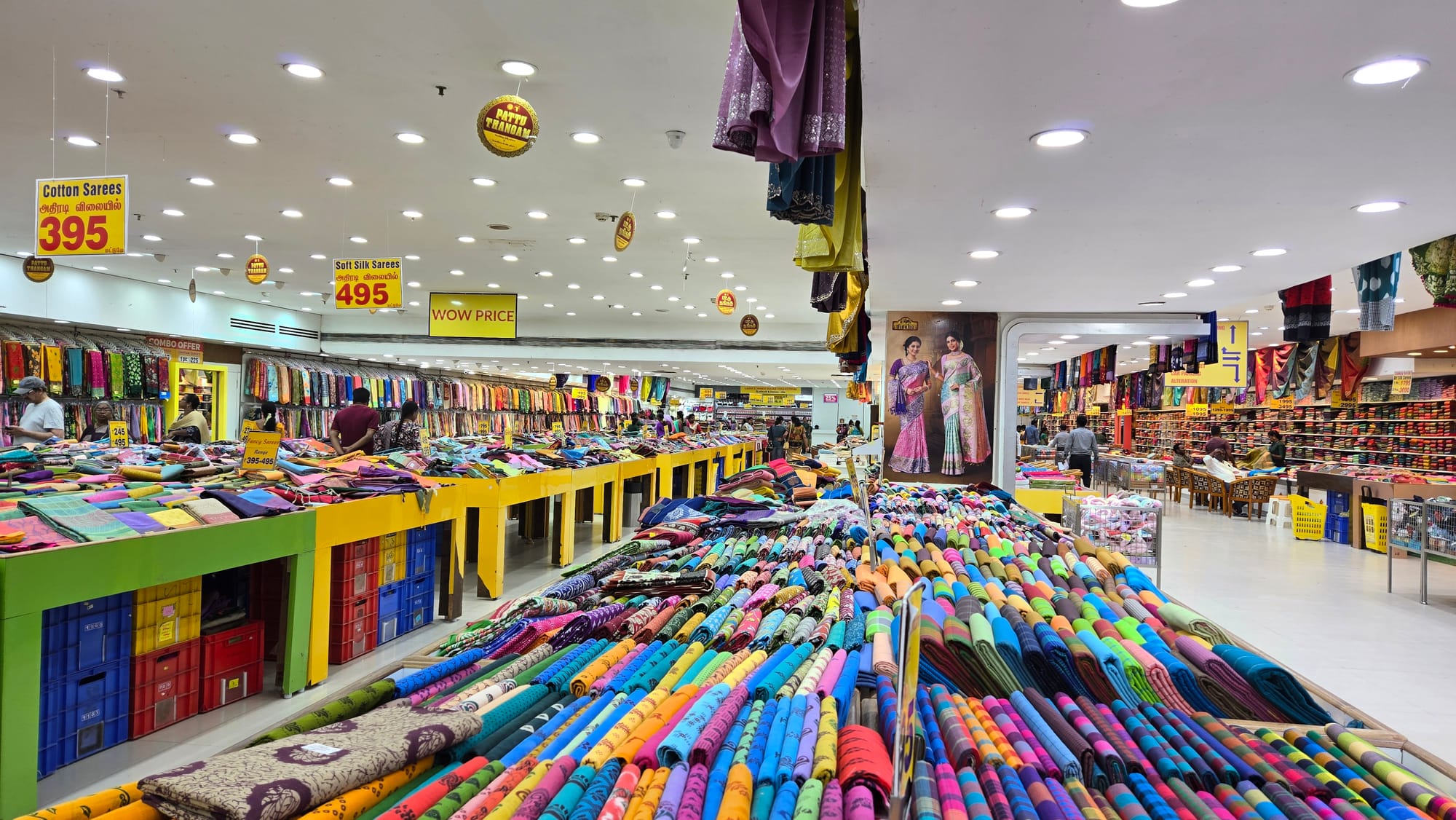
So the quest for the sungudi sarees began in earnest when we set out on our walking tour of Madurai on the first afternoon there. Streets and sidewalks were teaming with small vendors selling food, flower vendors, mostly women were weaving garlands with freshly picked jasmines. We went looking for coconut candy our youngest son and I both love. With a large bag of coconut candy in my hands, the next stop was a saree shop on a street close to our hotel. When we were at the front door, the store, Chennai Silks, looked very small. We stepped in through a smaller storefront to find a much larger store that was overflowing with sarees occupying a large city block. They had dozens of counters dedicated to different kinds of silk and cotton sarees from every corner of India; Kerala, Karnataka, Andhra Pradesh, Tamilnadu and many more. Each of these states is home to several traditional handloom weaves unique to their areas. The state of Tamilnadu is home to Sungudi, Arani and Kanchipuram silk and cotton weaves. This store has thousands of sarees in their jam-packed wall-to-ceiling shelving and rows of tables with sarees stacked on them on the floor. Other than narrow corridors for customers to walk through, the entire store had sarees wherever you look.
We located the sungudi saree counter in the middle of the store. Colorful sarees were overflowing the shelves behind the counter. The salesperson asked, "Do you want cotton or silk? We have both with and without blouse pieces in 6 and 9 yard lengths." I said, "Show me 6 yard cotton sarees without a blouse piece." The salesperson started showing me sarees in a cornucopia of colors, shades, and styles. I was selecting sarees, setting aside the ones I liked for a final pick. I ended up selecting a beige saree with a peacock-colored border with a blouse piece. Buying clothes at larger Indian stores is an experience. The salesperson shows you clothing, pulling them from shelves overflowing with clothing in different colors, sizes, and styles. Once you select the clothing you like, the salesperson takes you to another counter where you make the payment, then you are taken to another counter where they check your receipt with the word, “Paid” stamped on it in red ink before handing you a sealed bag with the clothes you purchased.
We walked back to our hotel room, adding one more shopping bag to my luggage, setting aside concerns about fitting them all in my carry-on for the return trip home. At that moment, I was celebrating my win by admiring the sungudi saree I had just bought. Well, the quest for the sungudi sarees wasn't complete. The next day, my spouse and I went to take pictures of four outer gopurams, monumental, ornate entrance towers on the east, west, north, and south sides of the Madhura Meenakshi temple. We completed our darshan, seeing the deity the night before, waiting in line for 4 hours to get a glimpse of the goddess, Madhura Meenakshi, carved in jade. We couldn't see the famed gopurams at night. When we went back to see them in the afternoon hours when the temple was closed, we were able to see the devotees resting on the outer perimeter of the temple waiting for it to open in the evening. We saw family groups sitting on the floor chatting, napping and resting. It was peaceful unlike the previous evening when we were among thousands of devotees standing in long lines waiting to get a glimpse of the goddess carved in jade. There were people milling around the streets lined with small shops selling food, flowers, coconuts, idols of the Hindu gods and ornately carved silver and bronze diyas in all shapes and sizes ranging from 2 inches wide to 3 feet tall. Compared to the previous evening, the temple grounds were peaceful and serene, glowing in the afternoon sunlight.
Once we circambulated the temple, admiring and taking pictures of the gopurams, we went looking for sungundi saree yet again finding them in a small store near the Meenakshi temple. The small store was much like the ones Amma used to take me to buy sarees for me when I was in college. One person was handling the cash register, a salesman was showing sarees, and an assistant was fetching sarees when the salesperson asked for more sarees in a specific color or style. The store had wall-to-wall cabinets from floor to ceiling all around 3 sides with carpeted seating in the middle of the store for showing the sarees to customers. I sat down in front of the salesman as he pulled out sarees in the colors of my choosing. He said, "I can speak Telugu, Kannada, Hindustani, Tamil and English." He showed me several sarees, speaking to me in Telugu, and talking to my spouse in Hindustani. He reached his depth of Telugu quickly, admitting he wasn’t very fluent in Telugu. I learned local names for colors; Madhur Meenakshi green named for the jade-colored goddess, Krishna blue named for the Hindu god, Krishna, Rama blue named for the Hindu god, Rama, Peacock blue named for the beautiful native bird, peacock. I ended up buying two sarees from that store, a beige-colored saree with a navy blue border at the bottom and kongu, the right end of the saree that goes over the left shoulder and dangles down for my cousin, and a red saree with a navy blue border for me. I had fun chatting with the salesperson in the process while thinking about the times I went shopping with Amma. This time around, I paid for the sarees instead of standing by Amma while she paid. I left the store carrying the two sarees wrapped in old newspapers with my spouse walking beside me.